
Wardrobe tag
- The National Park Service recommends storing textiles at 65 to 75 degrees Fahrenheit with relative humidity as close to 50 percent as possible; below 35 percent can embrittle them.
- The maximum illuminance it recommends for textiles is 50 lux, and light damage is cumulative and irreversible.
- Skirts, bias-cut dresses, heavily beaded costumes and garments with weak shoulders are best stored flat rather than hung.
A costume made for a film is built to survive a shoot, not a century. Whether you own a piece of studio history, a vintage evening dress or a handmade costume you want to keep, the same rules apply. The clearest public guide comes from the National Park Service, whose Museum Handbook has a full appendix on caring for textiles and costumes. Here is what it recommends, translated for a closet rather than a museum.
What damages costumes
The handbook names the usual suspects: temperature, relative humidity, light and pollution all affect the rate at which textiles deteriorate. Fibers readily take up and lose moisture, and swings in humidity cause dimensional change and mechanical stress that can lead to breakage. Dirt and dust are not just cosmetic: dust is high in silica, whose sharp surfaces cut and abrade fibers as they expand and contract.
Climate: steady and moderate
| Factor | NPS recommendation |
|---|---|
| Temperature | 65 to 75 degrees Fahrenheit |
| Relative humidity | As close to 50 percent as possible; under 35 percent can embrittle textiles |
| Light | 50 lux maximum, with all ultraviolet light filtered |
| Fluctuations | Avoid swings in temperature and humidity |
The handbook also advises against storing or displaying textiles in rooms with doors that open to the outside.
Light: damage you cannot undo
Light fades dyes, and it makes undyed textiles bleach or darken; it can also speed the deterioration of weighted silks. The handbook is blunt that light damage is cumulative and irreversible, and depends on the type, intensity and duration of the light. Its advice is to keep textiles in rooms without windows where possible, cover windows with drapes or blinds, and limit total exposure, even simply by turning out the lights. UV-absorbing window film reduces ultraviolet light but not overall brightness.
Hang it or lay it flat?
Hanging takes less space, but not every garment can take it. Before hanging a costume, the handbook asks four questions: are the shoulder seams strong and intact, is the fabric in the hanging area free of splits and holes, can the waistline support itself without strain, and if not, can waist tapes support it? If any answer is no, store the piece flat.
- Store flat: fragile costumes and garments weak at the shoulders, breeches and pants, dresses with fragile waistlines, skirts, heavily beaded costumes, and bias-cut garments such as some early 20th-century flapper dresses.
- Store flat or with minimal folding in an archival box: unconstructed clothing such as kimonos that use rectangular lengths of fabric.
- Hang only sound, well-supported garments.
Doing hanging storage right
Start with a wooden hanger, padded so its ends reach into the sleeve just beyond the sleeve seam. Add twill-tape waist supports for heavy or awkward garments. Give each piece a dust cover, which, the handbook says, protects against dust, light and abrasion, keeps the oils and acids of your hands off the fabric, stops fugitive dyes from transferring and keeps metallic embroidery, braid and buttons from catching on neighbors. In museum cabinets the handbook leaves at least 1.5 inches between garments.
Folding and handling
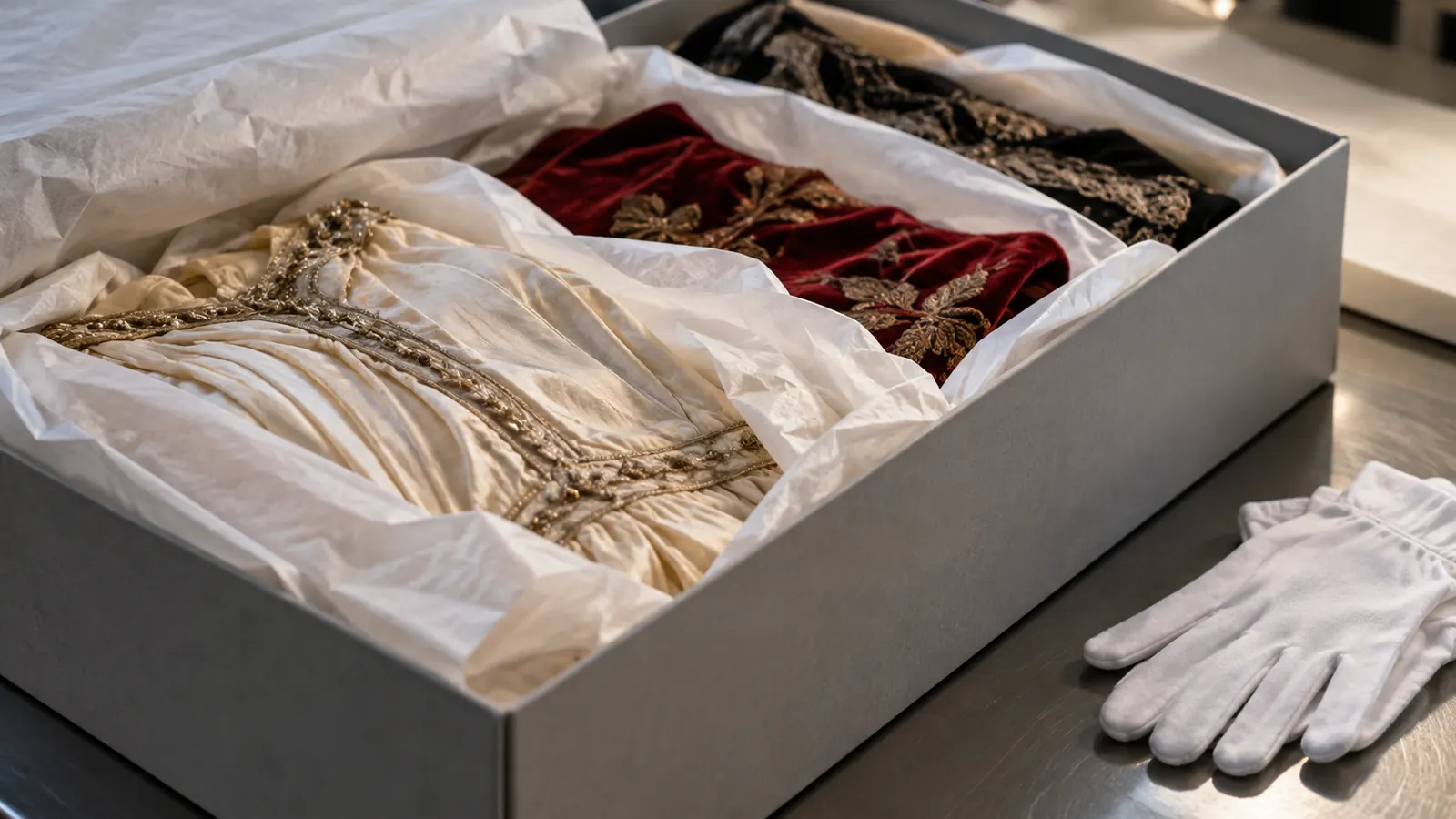
- Fold as little as possible. Textiles tend to break along fold lines over time; pad each fold with crumpled unbuffered, acid-free tissue paper.
- Pad the inside of costumes with the same tissue when boxing or moving them.
- Avoid stacking. When you must, interleave pieces with acid-free tissue and watch the weight on the bottom layers.
- Support a textile when you lift it; fabric is not rigid and can stretch or tear.
- Work on a clean, padded surface, and keep pens and ink away. The handbook says to use only pencil near textiles.
Moths, beetles and mold
Textiles are food. The handbook explains that clothes moths are drawn to protein materials such as wool, silk, hair, fur and feathers; the female lays eggs in the weave, and the larvae, which take on the color of what they eat, chew holes or thin the yarns. Carpet beetles also attack silk and wool, and silverfish and cockroaches graze on fabrics and glues. Mold and mildew grow in warm, damp places and leave irreversible brown stains. Starch, sizing, soil and stains attract pests too, so store garments clean.
Tip: Treat every new vintage purchase like a museum acquisition: keep it isolated from the rest of your wardrobe until you are sure it carries no insects. The handbook recommends exactly this for newly acquired objects.
A warning about old hats and furs
Hats made with fur, feathers or parts of birds and animals may carry pesticide residues, including arsenic. The handbook says bird and mammal skins prepared before the mid-1980s should be tested, and that suspect items should be handled with plastic gloves and a protective smock, followed by hand washing. That applies to vintage millinery as much as to museum specimens; see Buying Vintage Clothing and Costumes in LA: How to Inspect, What the Labels Tell You, and What to Avoid.
When to call a professional
Cleaning is where well-meant care does the most harm. The handbook singles out weighted silks, treated with metallic salts in the 18th and 19th centuries for a fuller drape: when aged they fracture and powder very easily, and washing and dry cleaning easily damage them. For a valuable or fragile piece, ask a textile conservator before cleaning it. To see how museums display costumes under these rules, visit one of the collections in Where to See Film Costumes in Los Angeles: Museums, Hours and What to Check First, and for how costumes are built in the first place, read How a Film Costume Is Made: From Script Breakdown to the Last Fitting.